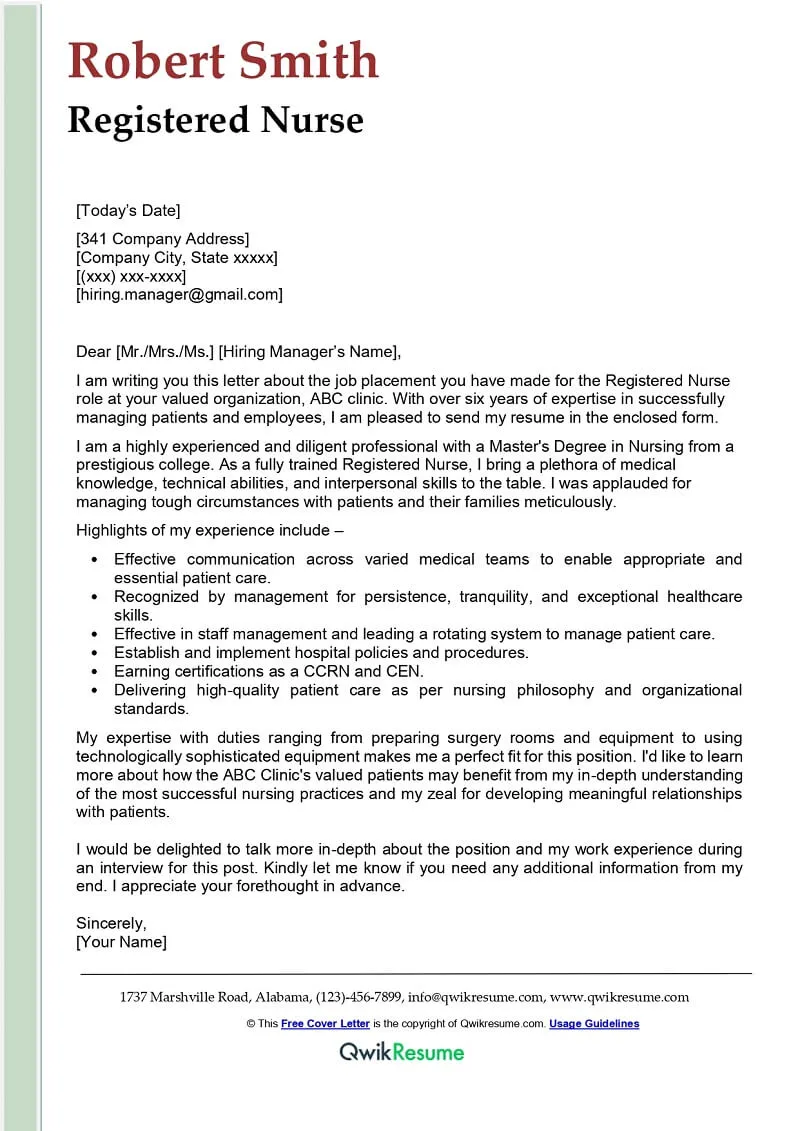
What is a Registered Nurse Cover Letter
A Registered Nurse (RN) cover letter is a formal document that accompanies your resume when you apply for a nursing position. It serves as an introduction to your qualifications, experience, and skills, allowing you to showcase your suitability for the specific role. Unlike a resume, which provides a summary of your professional history, a cover letter enables you to elaborate on your accomplishments, express your interest in the position, and demonstrate your personality and communication skills. Writing a compelling cover letter is crucial for making a positive first impression and increasing your chances of getting an interview.
Why Is a Cover Letter Important
A cover letter is a vital part of your job application. It gives you the opportunity to present your qualifications and skills in a way that a resume cannot. It also allows you to highlight your interest in the specific position and company. Many employers use cover letters to screen applicants, and a well-written letter can set you apart from other candidates. A cover letter helps you to demonstrate your communication skills, show your enthusiasm for the job, and make a personal connection with the hiring manager. Failing to include a cover letter when requested can sometimes result in your application being overlooked, regardless of your qualifications. So, it’s a critical tool to help you to land the job of your dreams.
Essential Sections of a Registered Nurse Cover Letter

A well-structured cover letter follows a standard format that includes specific sections designed to present your qualifications and interests effectively. Each section serves a purpose, contributing to the overall impact of your application. Mastering the structure will improve the effectiveness of your applications. The following sections are essential for your registered nurse cover letter. Ensuring that all the correct elements are included will demonstrate to the hiring manager that you’re a qualified candidate and seriously interested in the position. Your attention to detail and commitment to excellence will immediately shine through.
Header Section
The header section of your cover letter should include your contact information, such as your full name, address, phone number, and email address. It should also include the date and the hiring manager’s name and title, if known. This section is crucial for providing the hiring manager with the information they need to contact you. The header should be formatted professionally, using a clear and legible font. Always ensure the information provided is up-to-date and accurate to avoid any communication issues. A well-formatted header demonstrates your attention to detail and professionalism.
Contact Information
Your contact information should be easily accessible at the top of the cover letter. Include your full name, phone number, email address, and professional social media profiles, if applicable. Use a professional email address and ensure your voicemail greeting is also professional. Double-check the accuracy of all your contact information to avoid any potential delays in communication. Make sure it is clear and easy to read. By providing comprehensive and correct contact details, you make it straightforward for the employer to reach out to you for an interview or further inquiries.
Greeting the Hiring Manager

Start your cover letter with a professional greeting. If you know the hiring manager’s name, address them directly, such as “Dear Mr./Ms. [Last Name].” If you don’t know their name, use a general greeting like “Dear Hiring Manager.” Avoid overly casual greetings such as “Hi” or “Hello.” Use a formal and respectful tone to establish a positive first impression. Personalizing the greeting shows that you’ve taken the time to research the company and the position. The right greeting sets the tone for the rest of your letter, communicating your professionalism and attention to detail.
Body Section
The body section of your cover letter is where you showcase your qualifications and express your interest in the position. This section should be concise, engaging, and tailored to the specific job requirements. It typically consists of an opening paragraph, which introduces you and states the position you’re applying for; a body paragraph or two, where you highlight your relevant skills and experiences; and a closing paragraph, where you express your enthusiasm and call to action. Crafting a well-structured body section is essential for making a strong impression and convincing the hiring manager that you are the ideal candidate for the role. It allows you to present a compelling narrative that highlights why you stand out.
Opening Paragraph
In your opening paragraph, state the position you are applying for and where you saw the job posting. Briefly introduce yourself and mention your key qualifications or skills that align with the job requirements. Express your enthusiasm for the position and the company. Make it clear why you are interested in this specific role. Your opening paragraph sets the tone for the rest of the letter, immediately capturing the hiring manager’s attention. It should be concise, compelling, and tailored to the job description. Highlight your best attributes to make a great first impression and encourage the reader to continue reading.
Highlight Your Qualifications

Use the body of your cover letter to highlight your qualifications. Carefully review the job description and identify the key skills and experiences the employer is seeking. Provide specific examples from your previous roles where you have demonstrated these skills. Quantify your achievements whenever possible to make a more compelling case. For instance, if you improved patient satisfaction scores, provide the percentage increase. Tailor your cover letter to showcase how your abilities align with the job requirements. This targeted approach will convince the hiring manager that you are the right fit for the position.
Focus on Relevant Experience
Focus on the experiences most relevant to the nursing position. Highlight your clinical experiences, such as working in specific units (ICU, ER, etc.), patient care responsibilities, and any specialized training you have. If you have experience with certain medical equipment or electronic health record (EHR) systems, be sure to mention it. Use action verbs to describe your responsibilities and achievements. For instance, use phrases like “managed patient care,” “administered medications,” or “collaborated with a healthcare team.” This section should demonstrate your hands-on experience. Include any relevant certifications or licenses you hold.
Showcase Your Skills
Highlight both your hard skills and soft skills in your cover letter. Hard skills are technical abilities like administering medications, using medical equipment, and performing specific nursing procedures. Soft skills include communication, teamwork, problem-solving, and empathy. Provide examples of how you have used these skills in previous roles. For example, describe how you effectively communicated with patients and their families or how you resolved a conflict within a healthcare team. Showcasing a balance of both types of skills shows that you are a well-rounded candidate. Ensure to include the skills listed in the job description to show how well you meet the requirements of the position.
Closing Paragraph

In your closing paragraph, reiterate your enthusiasm for the position and the company. Summarize your key qualifications and skills, reinforcing why you are the best candidate. Express your gratitude for the hiring manager’s time and consideration. Include a call to action, such as stating your availability for an interview. Ensure your closing is polite, professional, and leaves a positive final impression. Make sure the letter ends with a strong note, clearly conveying your interest and readiness to move forward in the hiring process. A well-crafted closing paragraph can increase your chances of securing an interview.
Express Enthusiasm
Express genuine enthusiasm for the position and the company. Explain what attracts you to this specific role and why you are excited about the opportunity to contribute to the healthcare team. Research the company’s mission, values, and recent achievements to demonstrate your interest. Mention any company values that resonate with you. This shows that you’re not just looking for a job but are genuinely interested in the company’s work and culture. Your enthusiasm can make you stand out from other applicants. Expressing your enthusiasm helps build a personal connection with the hiring manager, making them more inclined to consider your application favorably.
Call to Action
Include a clear call to action in your closing paragraph. State that you are available for an interview and eager to discuss your qualifications further. Provide your contact information again and thank the hiring manager for their time and consideration. Indicate your willingness to provide any additional information. Make it easy for the hiring manager to take the next step. A well-defined call to action signals your interest in the position and makes it simple for the employer to contact you. Make sure to proofread the section to avoid any errors. Conclude with a professional closing such as “Sincerely” or “Best regards,” followed by your name.
Formatting Tips for Your Cover Letter

Proper formatting is essential for creating a professional and readable cover letter. Consistent formatting improves the readability of the document and ensures the hiring manager can easily find the information they need. Using the correct font, spacing, and layout will make a good impression and enhance the overall impact of your application. Ensure your cover letter is well-organized and visually appealing. Pay close attention to details, such as margins, spacing, and font size. These formatting elements are critical for conveying a sense of professionalism and attention to detail. A well-formatted cover letter shows that you care about the presentation of your application.
Choose the Right Font
Select a professional and easy-to-read font for your cover letter. Some common and well-regarded choices include Times New Roman, Arial, Calibri, and Helvetica. Use a font size between 10 and 12 points to ensure readability. Avoid using overly stylized or decorative fonts, which can distract from the content. Maintain consistency in font size and style throughout the entire document. Choose a font that conveys professionalism and is easy on the eyes. Consider the company’s branding. Ensure your font choice is easily readable on various devices and printouts. Professional fonts help maintain a consistent and professional look for your cover letter.
Keep It Concise
Keep your cover letter concise and focused. Aim for one page in length. Hiring managers are busy and typically spend only a few seconds reviewing each application. Get to the point quickly, highlighting your most relevant qualifications and experiences. Use short paragraphs and bullet points to improve readability. Avoid unnecessary jargon or lengthy explanations. Make every word count. Being concise demonstrates respect for the hiring manager’s time and shows you can communicate effectively. Keep your writing clear, direct, and easy to understand, focusing on the most important information.
Proofread Carefully

Proofread your cover letter meticulously before submitting it. Check for grammar, spelling, and punctuation errors. Use a spell-checker and grammar checker, but don’t rely solely on these tools. Read the letter aloud to catch any awkward phrasing or typos. Have a friend or colleague review it for you. Errors can undermine your credibility and make you appear unprofessional. Attention to detail is a crucial skill for nurses, and a polished cover letter shows that you possess this skill. Take your time to review the letter before sending it. Ensure that all sentences are well constructed and that the tone is professional and respectful.